My Stomping Grounds in Sylhet
My hometown is Sylhet. I lived there until about ten, but after we moved to Dhaka, I gradually became estranged from Sylhet. This was partly because Shawkat House, my grandfather's sprawling estate of several bungalows where I spent my first eight years, was sold in 1973. With it went a lot of my childhood memories. Another reason was that I hardly had any friends left in Sylhet. Also, in the 80s and 90s, due to poor infrastructure development and population pressure, Sylhet became congested and unpleasant. This has improved significantly in recent years.
Since returning to Bangladesh I have made several trips to Sylhet to rekindle the relationship, as it were. Here are some pictures of the stomping grounds of my childhood.
The only remaining original Shawkat House bungalow. This was the "outer" building and my Father's office.
This gate led to the inner bungalows and courtyards. Unfortunately the entire inner structure has changed so much that I could not recognize it.
Across the street from Shawkat House is the pond where I learned to swim. I also did a fair amount of pearl-diving here at the ripe age of eight and gave the largest pearl to my Mother. She had a ring made around it and, years later, gave it to my wife.
Next door to our house was this "moholla" called Shekh Para. In the front there were several date palms and a large pond. I was happy to find a palm standing.
But the pond was filled in with sand.
Out of Shekh Para came several illustrious people, including the Qureshi family, now in London, which has three elected London City Councillors from the same family. Must be a record of some kind!
A few doors down from Shawkat House was Shadhu Babu's house. He is a friend of the family, and his daughter married R. P. Saha's son. (R. P. Saha was a prolific industrialist and a prominent philanthropist of Bangladesh. Both Mr. Saha and his son were killed by the Pakistan Army in 1971. Shadhu Babu is alive.)
The compound of Shadhu Babu's house had a massive "Bokul" tree. My grandmother and I used to stop there during our morning walk and pick the tiny, fragrant flowers. The tree is gone, leaving this patch of land.
My first school was Blue Bird School. The school moved several times when I was attending it and occupied this building - now a dilapidated government office - when I was in 4th and 5th grade.
Our Assembly took place in the hall just inside this entrance.
Nowadays Blue Bird (located in a nice new location) is a BIG school, going all the way to 12th grade :-)
Also within walking distance was "Nanubasha" - my maternal Grandparents' home. There were many children my age there. Hence I went there every chance I got. This is the entrance with the large "dalan" structure dating back to 1911. My Nanu, and several families of my Nana's relatives, lived in separate bungalows in the inner house, taking the path curving around the side of the Dalan. (My Nana passed away before I was born.)
Another view of the "Dalan", made in 1911 with stone, bricks and sand before cement became available.
Nanubasha is formally known as "Ahia Villa". Mr. Ahia, also known at Jeetu Mia, was one of the most colorful and eminent residents of Sylhet in the early 1900s, and the first one with a motor car. This is the tomb of Mr. Ahia and Sara, his first wife.
Two or three years ago, an incredibly ill-conceived government plan was drawn up to build another bridge on the Surma that would effectively destroy Ahia Villa (due to road widening required for this bridge.) It boggled the imagination that such a historical house - Gandhi had spent time in this house, Dr. Syed Mujtaba Ali had studied there - could be cast aside so casually. Luckily a storm of protests followed, and the plan, while still alive, has been slowed. It needs to be stopped.
Incidentally, if you write a letter to someone in Ahia Villa, it is enough to address it as "Ahia Villa, Sylhet" and the post office will deliver it. The only house in Sylhet for which you don't need a numbered street address!
(I am grateful to Dr. Shama Ali for pointing out the R. P. Saha connection.)


Friday, May 18, 2007
Lychees (photos)
Lychees have ripened. They are selling for between Tk 160 and Tk 200 per hundred (1 USD = Tk 70 approx.) Here are some pictures.
Yummy baby!
They are all over the place. Above you...
and behind you...
... there are doubledecker lychees...
...and lonely lychees.
Adults love them...
... and so do kids!
"You toucha my lychees I puncha your nose!"
Lychee leaves and anchor.
The sellers were out in force. "They are Kora (extreme) sweet!"
"Here, try a sample if you don't believe me."
"Heck, they'll even grow hair on your chest!"
People-less
Some pictures I took today.
Minaret of a Mosque:
A Dhaka alley. Sign on blue door says "Happy New Year" (Bangla NY was April 14)
Another Dhaka alley, empty for about two seconds!
A framing shop:
A shirt being dried in the sun:
A Tukri, used to carry vegetables for selling door to door:
Vegetables for sale at open-air market:
Bouddha Purnima
Yesterday was Bouddha Purnima, the most important religious event for the 1 million Buddhists who live in Bangladesh. I went to the Buddhist Temple in Kamalapur to see how it was celebrated. Here are some pictures.
Picture of Gautama at the temple. He was born, became Buddha, and passed away (attained Nirvana) on this full-moon of Boishakh month:
Stupa at the entrance to the temple:
Family praying inside temple:
Mom offers "proshad" as son checks out the man with the camera:
Boys waiting in line to offer prayers:
Girl dressed in her "Purnima Best":
Party time!
Bring on the music...
Toys for the boys:
I was not clear about the meaning of the money tree, but it was part of the prayers:
Woman entering the festival:
Serious monks:
Laughing monk:
Mad Dogs, Englishmen and Yours Truly
(May 1) It must have been the hottest day of the year today. I needed to go to Nilkhet (from the Baridhara area). Since it was a holiday, I expected roads to be clear and decided to bicycle, starting out at 11am.
Unfortunately I chose the "ugly way" to get there - by way of Tejgaon Industrial Area. It was so hot that the ice cold water in my water bottle turned lukewarm in ten minutes. Heck, it was so hot that the green arrow of the traffic signal started looking like a lime popsicle to my bleary eyes.
Anyways, I got there safely and got my work done. BTW, Nilkhet is an adventure in itself. This place, home of 3 or 4 used bookstores thirty years ago (I bought one volume of Britannica here in 1974) is now a sprawling book empire of hundreds of small shops. They do everything - sell used books, copy books, bind books, make covers, cut paper, glue stuff together, sell stationery - to do with books.
On the way back, I decided to take the scenic route - turning right after going a ways past Asad Gate, along Zia Udyan, behind Parliament.
I stopped twice to refill my drinking water. The worst moments were when I was stuck in traffic exposed to direct sunlight (and in Industrial area, behind a belching bus.) I was ok when moving, because of the breeze I felt during bicycling. Here are some pictures.
Krishnachuras at full bloom.
The lake looked refreshing.
A brilliant move by the boy: cool down in the water!
Modern-day Visti-wallah (water-seller - remember the Humayun story?)
Tormooj (Watermelons)
The heat is on. Watermelons are in season.
It's a sweet antidote to the heat.
Boats coming into Dhaka are loaded with melons.
Unloading from the lower deck...
...and loading into a boat...
Boys who helped unload show their reward.
This boy had to swim ashore with his one.
Man taking melons home to village.
Melons on display after rain.
A more attractive display.
Another way to show off.
Green (Photos)
As Borsha (rainy season) approaches, green asserts itself in the countryside.
Tiny Jamburas starting their life.
Lily flower buds.
Patabahar leaves.
Rubber leaves.
Creepers.
Unknown (fern?).
Fern.
Weed.

Young Bangladesh

My uncle told me this story years ago. During President H. M. Ershad's time, a village was facing a disaster. Mr. Ershad had ordered officials to deal with the matter urgently. They had worked hard and disaster was averted. Now the President was visiting in a helicopter. When his helicopter landed in a field, it was completely surrounded by hundreds of joyous kids. Mr. Ershad apparently looked at the official next to him, pointed outside, and said, "We have averted disaster today, but what will happen tomorrow when all these kids must be taken care of?"
Well it looks many of those kids are doing Bangladesh proud today. One example is the really young team that defeated India at World Cup Cricket yesterday. There are several teenagers in the team. As the Daily Telegaph said,
"These Bangladeshis have an impish verve all their own. Their youngsters are not only ardent but cheeky and streetwise. They are the youngest Test nation but they don't die wondering."
Ah, all those years of eating chotpoti/fuchka and playing truant/cutting classes to practice cricket pays off! A day like this is enough to make a fan out of a crusty cricket-agnostic like myself.
Another example is GMB Akash, a young photojournalist, who was chosen in an important list of worldwide top 30 "New and Emerging Photographers to Watch in 2007". Akash is 30, the only South Asian in that list.
Yet another example is young novelist Tahmima Anam who I have mentioned on this blog before.
And so the list goes on. Naeem Mohaiemen, in an essay, commented on how young Bangladeshis who have been successful abroad rarely get the rave reviews they deserve in their homeland. Yes, they deserve more attention. Problem is that our culture has a historical tendency to tilt towards elders and towards the past.
But today I see a change. So many of the kids I meet at different occasions - from the classrooms and halls at BRAC U. where I teach, to budding software engineers at various firms or friend's houses, to school and college students I run into while wandering or photographing - show confidence, self-esteem, and yes, verve.
The future of Bangladesh is in good hands.
Seasons Turn
Seasons turn swiftly in Bangladesh, like some other things. Last week I was enjoying the cool breezes of the end of winter on my skin. Yesterday it was suddenly hot.
In the farm, in just three weeks, the bald trees...
...had turned green...
... with leaves dripping color.
Of course the usual suspects still prowled.
But the bright yellow flowers of fall that had attracted so many critters...
... were gone, the dying plant now busy creating seedlings in place of flowers.
Even the ugly roadside plants...
...jumped into spring by producing pretty flowers.
The creepers of the forest were also out looking for some action.
But the best part of spring were these intensely fragrant Jambura blossoms. Thakur Mohashoi, "Fagune tor aamer boler ghraan" is not nearly as sweet-smelling as these, but somehow "Faguney tor jamburar boler ghraney" does not sound so poetic!

I Like These Signs
The "do not pee here" signs are sometimes hilarious. This one threatens 10 strikes by shoe, as well as Tk 50 ($0.75) fine. Is that you Gopal Bhaar?
Boi Mela (Photos)
I went to the Ekushey Boi Mela (book fair) yesterday. It is on Bangla Academy grounds and runs until Feb 28th.
What it's all about...
The road leading to the Mela covered by banners.
Onyoprokash was the busiest seller - one buyer gets change over heads.
The environment (specially trees) lent some drama (the sign says Shikor - "root")
Three veiled women who were shopping for books.
This man could not wait until getting home to read his new acquisition.
Publishers found novel ways to market books.
Salam, one of the first martyrs of the Language Movement
Friends looking through a publisher's catalog.
A selection of Bangla IT books in the Mela.
Parents' duties don't stop with purchasing the books :-)
I liked the Boi Mela a lot, but next time I will leave the camera behind. It was schizophrenic and stressful playing reader and photographer simultaneously.
I bought one book, called "Bangladesher Protno-Shompod" (Archaeological Treasures of Bangladesh) that is encyclopedic - and has directions to many many historical buildings and ruins.
Two Points of View
Little Girl: Man, what a horrible morning! There I was, up bright and early, but Abbu and Ammu wanted to sleep in. I heard Bhaiya and Apu playing by the pond, so I came to join them. Bummer, they would't take me in their game. What could I do? No one would even get me a hanky to clean my nose. So I decided to sit by the pond, stare at the water, and think. Then I hear a noise, turn around, and - YIKES! - this big man had snuck up behind me with a black shiny thing in his hand, pointing it at me. I screamed. I am sure he had a sack in which he wanted to carry me off. And he kept on saying "foto foto." What the heck is a foto? I screamed and screamed and ran for my life, even though Bhaiya and Apu tried to stop me and look at that horrible man. No way. I want Ammu. Ammu! AMMU!
Me: I am bicycling through this village early in the morning, enjoying the scenery and taking pictures. I see two kids playing on the yard by a pond, and another little girl sitting by the pond, staring into the water, lost in thought. It was a perfect moment. Not wanting to disturb her, I parked my bicycle a few feet away and approached the child from behind, very quietly. Just as I composed the photo through the viewfinder and touched the shutter, she heard me and turned around. She froze for a split second, eyes widening in fear, then found her voice, started screaming and ran away. I said "it's just a photo, don't worry, I won't hurt you" and her brother and sister tried to calm her down but to no avail. So I went back to my bicycle and waited for a few minutes. Then I checked back - her screaming had stopped and she had calmed down. But the poor thing was traumatized enough for one day, so I left.
The photo: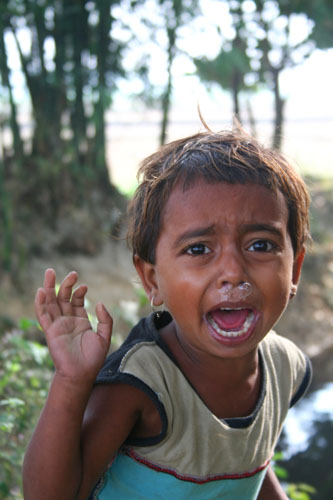
Brahmins and Naval Architects (Photos)
Last Friday we went for a 50-km bicycle ride out of Dhaka. It was a very foggy day:
We biked east and then south of Dhaka, the last 5 km along the banks of the Sheetalakhya. This was my first time on that road. We spotted a shipbuilding yard on the bank and stopped to take a look. Workers were building a large, 200+ feet long ship.
This gentleman is the owner of the operation. He said the metal comes from Chittagong, and is built into the ship which is sent back to Chittagong by river. Then it is used to move materiel between Chittagong and Dhaka. Takes about 8-9 months to make such a large ship. All the work is done on the premises.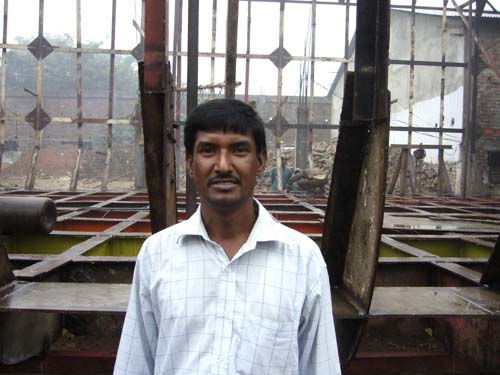
These two workers were painting the hull. They used a rag instead of paintbrushes to reach all the nooks and crannies (to seal them from rusting?)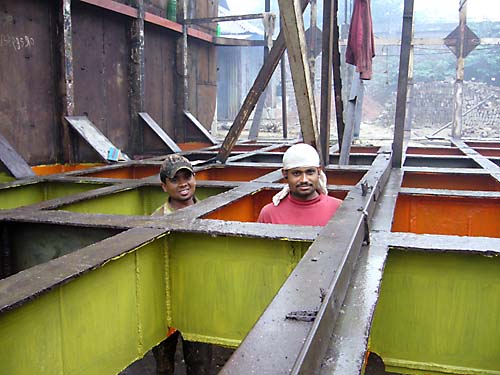
I asked them about Keraniganj, where I had seen large boat building facilities. They said it had shifted here due to people moving into Keraniganj area (gentrification.)
I hope to be back when they lower the boat onto the river. That should be quite a sight.
On our way back, Peter spotted some color at a distance from the road and we stopped to investigate. We walked to a field behind a village. It turned out a Hindu Puja - and an accompanying Mela - was in progress. It was called Purnima Puja or Dhamai(?) Puja. This priest was leading the prayers.
The air was festive, with music and drums.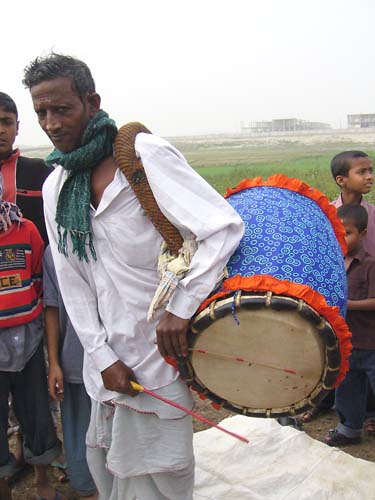
The people praying were mostly women.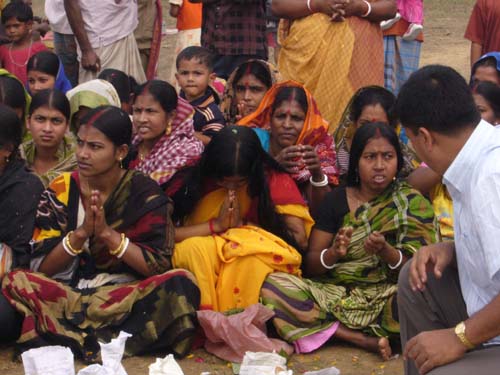
The mela offered toys for the kids.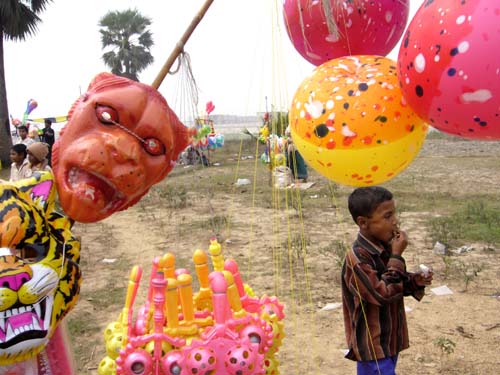
This gentleman asked me to take his picture with his granddaughter. I said I thought it was her daughter - he looked so young. He gave a hearty laugh.
This girl had got her own balloon and was playing on the side by herself.
At night, it was full-moon, so indeed it was a Purnima. All in all, great day of exploring. Many thanks to my bicycling companions Peter and Mehreen.
Boroi Season
Boroi season is in full swing here in Dhaka. Kids are having a blast, with the vendors posted strategically outside school gates. I have tried at least four varieties, though I am sure there are many more. Prices are high. If you buy from the posh side of town, you can pay a ridiculous Tk 100/kg for the premium Oval and Aapel Borois. In other places, the minimum is still a high Tk 60/kg.
That said, the Borois I tried were absolutely delicious. The Aapel (Apple) Boroi was the sweetest, but the oval one was the best overall because of its extra crunchy texture. And the round deshi boroi had great flavor with just a little tartness.
Here are some pictures.
Aapel Borois
Oval Borois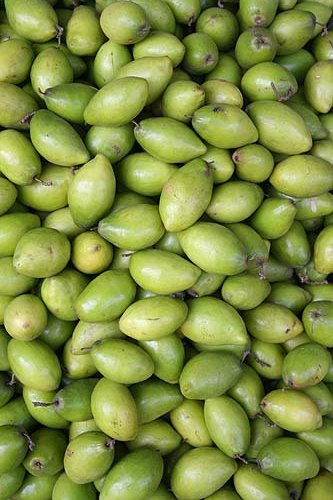
Deshi Borois
Incidentally, I tried a Boroi off of a tree in Ayutthaya, Thailand, recently and it tasted just like our Deshi Borois.
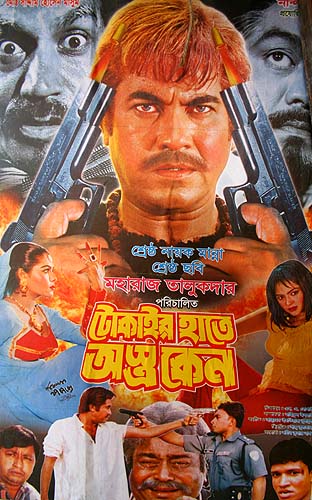
The Burnt Bus
Yesterday morning, I overheard a bus conductor arguing about "trouble" near Wireless Gate in Mohakhali. Walking there, I found the remains of this burnt bus.
Stepping into it I was filled with sadness. I imagined all the passengers these seats had carried to and from work, or school, or friends and relatives' houses - even secret rendezvous. Some had gotten seats to sit, others had travelled standing, yet others maybe dangling from the door (don't see much of that these days.) How many Aamra and other Snack-wallahs had sold food inside here? And what about those small quarrels that passengers have with the conductors? Maybe a father had treated his son to Shishu Park on a Friday, sitting on that last row on the left? Maybe a beggar had sneaked past the conductor and sang sad songs to earn something? Had any pickpocket operated in this bus?
Well, there you have it. One less bus to take people where they need to go.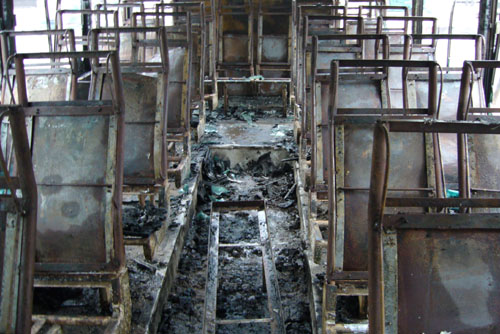
A Little Flag Waving (Photos)
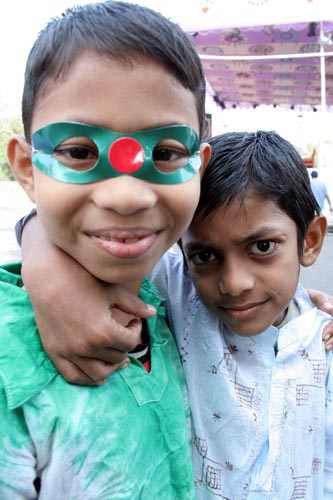
16th December is Victory Day for Bangladesh - a good day for flag waving :-)




courtesy by...
SAGAR RESTUARANT
 |
Sagar Restaurant offers an extensive choice We provide 100% halal meat.of traditional Bangladeshi, Pakistani and Indian cuisine together with new mouthwatering recipes, but if you have a preferred dish that isn't on the menu, please don't hesitate to ask the management who will be more than happy to have our chef specially prepare it for you. |
Jamaica, New York 11432
PHONE: 718-298-5696
718-657-2855
718-213-4338(for catering only)
Web Site: www.sagarfood.com


1 comment:
Last time I was in Sylhet (August 2007), I was very frustrated with accessibility to information.
Hence I created www.zindabazar.mobi, as an attempt to build a fun and easy to use platform where people can access information of organisations via mobile phones. The site also allows users to post things that they want to sell..
Post a Comment